

 Image 1 of 1
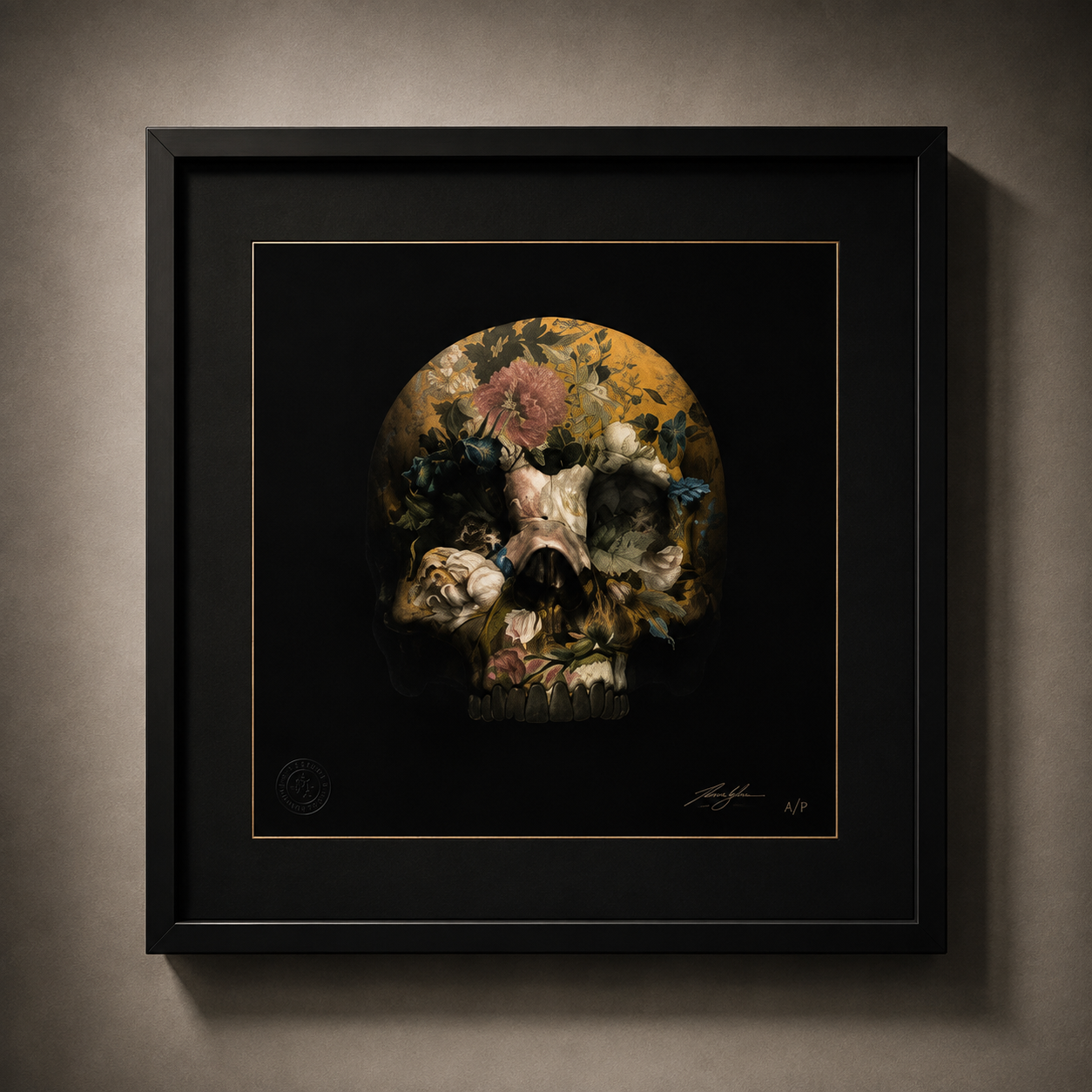
THERE IS STRONG SHADOW WHERE THERE IS MUCH LIGHT (YELLOW)
Magnus Gjoen
2019
50 × 50 cm
Signed and numbered Artist Proof
Archival pigment inks and silk-screen varnish on 308gsm cotton rag
From The Allun Lewis Collection
THE STORY BEHIND THE PIECE
Sometimes beauty becomes more interesting when you discover what is hiding underneath it.
At first glance, There Is Strong Shadow Where There Is Much Light (Yellow) is extraordinarily decorative.
The yellows and golds immediately draw your eye. Flowers emerge from the darkness, intricate patterns appear across the surface and, sitting beneath all of that beauty, is the unmistakable form of a human skull.
But once you understand where Magnus drew some of his inspiration from, the piece becomes considerably darker.
BEAUTIFUL. BUT TERRIFYING.
Magnus connects these works to the opium dens that appeared in Victorian East London during the nineteenth century.
It's a fascinating reference.
He brings together Victorian-style florals and Chinoiserie-inspired colours with the skull, imagining something that could almost have appeared through the altered perception of somebody smoking opium.
Magnus describes the result perfectly:
“Beautiful but at the same time terrifying.”
And once you know that, it's difficult to look at the artwork in quite the same way again.
What initially appears decorative begins to feel hallucinatory.
The flowers aren't simply sitting on the skull.
They almost seem to be growing through it.
Reality and imagination start merging together.
THE YELLOW
For me, the yellow colourway makes that contradiction particularly interesting.
Yellow should feel optimistic.
Sunlight. Warmth. Energy. Life.
Yet here it surrounds one of art's oldest symbols of mortality.
That creates a strange visual contradiction.
The colour tells you life.
The skull tells you death.
And somehow Magnus allows both ideas to occupy exactly the same space.
It's one of the reasons I enjoy having different interpretations of related works within the collection.
Change the colour and you haven't necessarily changed the subject.
But you can completely change the way the subject feels.
THERE IS STRONG SHADOW WHERE THERE IS MUCH LIGHT
Then there is that extraordinary title.
There Is Strong Shadow Where There Is Much Light.
For me, those words are almost as important as the image.
Because light and darkness aren't always separate things.
Sometimes one allows us to understand the other.
The brightest periods of our lives can exist alongside extraordinarily difficult ones. Beauty can emerge from uncomfortable places. Something can appear wonderful while carrying a much darker story beneath its surface.
And perhaps that is what I take from this piece.
The presence of darkness doesn't necessarily extinguish the light.
Sometimes it makes us notice it.
LOOK AGAIN
That's something Magnus's work repeatedly makes me do.
Look once.
Then look again.
From across the room, this is a beautiful decorative skull.
Move closer and you begin discovering flowers, patterns, colours and tiny fragments of imagery.
Understand the historical references and another layer appears again.
Suddenly you're thinking about Victorian London, opium, altered perception, mortality and the strange relationship human beings have always had with escapism.
The artwork hasn't changed.
Only your understanding of it has.
And I think that's fascinating.
WHY IT BELONGS IN MY COLLECTION
This is exactly the kind of work that represents why I collect Magnus.
There is immediate visual beauty, but beauty is only the invitation.
Behind it sits history.
Symbolism.
Mortality.
Culture.
And just enough darkness to make you question what you're actually looking at.
I don't need an artwork to give me an answer.
I'd much rather it gave me another question.
LIFE THROUGH ANOTHER PERSON'S LENS
Perhaps that's also why this piece fits so naturally with the philosophy behind my wider collection.
Magnus has taken historical references, classical symbolism and his own imagination and given us his interpretation of them.
I can understand what he saw.
But I'm still free to see something different.
Someone else standing in front of the same piece may see something different again.
The freedom to see through somebody else's eyes without surrendering our own.
And perhaps that's the real beauty of this particular work.
At first, you see the light.
Then you notice the shadow.
And eventually you realise that one may never have been quite as powerful without the other.
From The Allun Lewis Collection
Magnus Gjoen
2019
50 × 50 cm
Signed and numbered Artist Proof
Archival pigment inks and silk-screen varnish on 308gsm cotton rag
From The Allun Lewis Collection
THE STORY BEHIND THE PIECE
Sometimes beauty becomes more interesting when you discover what is hiding underneath it.
At first glance, There Is Strong Shadow Where There Is Much Light (Yellow) is extraordinarily decorative.
The yellows and golds immediately draw your eye. Flowers emerge from the darkness, intricate patterns appear across the surface and, sitting beneath all of that beauty, is the unmistakable form of a human skull.
But once you understand where Magnus drew some of his inspiration from, the piece becomes considerably darker.
BEAUTIFUL. BUT TERRIFYING.
Magnus connects these works to the opium dens that appeared in Victorian East London during the nineteenth century.
It's a fascinating reference.
He brings together Victorian-style florals and Chinoiserie-inspired colours with the skull, imagining something that could almost have appeared through the altered perception of somebody smoking opium.
Magnus describes the result perfectly:
“Beautiful but at the same time terrifying.”
And once you know that, it's difficult to look at the artwork in quite the same way again.
What initially appears decorative begins to feel hallucinatory.
The flowers aren't simply sitting on the skull.
They almost seem to be growing through it.
Reality and imagination start merging together.
THE YELLOW
For me, the yellow colourway makes that contradiction particularly interesting.
Yellow should feel optimistic.
Sunlight. Warmth. Energy. Life.
Yet here it surrounds one of art's oldest symbols of mortality.
That creates a strange visual contradiction.
The colour tells you life.
The skull tells you death.
And somehow Magnus allows both ideas to occupy exactly the same space.
It's one of the reasons I enjoy having different interpretations of related works within the collection.
Change the colour and you haven't necessarily changed the subject.
But you can completely change the way the subject feels.
THERE IS STRONG SHADOW WHERE THERE IS MUCH LIGHT
Then there is that extraordinary title.
There Is Strong Shadow Where There Is Much Light.
For me, those words are almost as important as the image.
Because light and darkness aren't always separate things.
Sometimes one allows us to understand the other.
The brightest periods of our lives can exist alongside extraordinarily difficult ones. Beauty can emerge from uncomfortable places. Something can appear wonderful while carrying a much darker story beneath its surface.
And perhaps that is what I take from this piece.
The presence of darkness doesn't necessarily extinguish the light.
Sometimes it makes us notice it.
LOOK AGAIN
That's something Magnus's work repeatedly makes me do.
Look once.
Then look again.
From across the room, this is a beautiful decorative skull.
Move closer and you begin discovering flowers, patterns, colours and tiny fragments of imagery.
Understand the historical references and another layer appears again.
Suddenly you're thinking about Victorian London, opium, altered perception, mortality and the strange relationship human beings have always had with escapism.
The artwork hasn't changed.
Only your understanding of it has.
And I think that's fascinating.
WHY IT BELONGS IN MY COLLECTION
This is exactly the kind of work that represents why I collect Magnus.
There is immediate visual beauty, but beauty is only the invitation.
Behind it sits history.
Symbolism.
Mortality.
Culture.
And just enough darkness to make you question what you're actually looking at.
I don't need an artwork to give me an answer.
I'd much rather it gave me another question.
LIFE THROUGH ANOTHER PERSON'S LENS
Perhaps that's also why this piece fits so naturally with the philosophy behind my wider collection.
Magnus has taken historical references, classical symbolism and his own imagination and given us his interpretation of them.
I can understand what he saw.
But I'm still free to see something different.
Someone else standing in front of the same piece may see something different again.
The freedom to see through somebody else's eyes without surrendering our own.
And perhaps that's the real beauty of this particular work.
At first, you see the light.
Then you notice the shadow.
And eventually you realise that one may never have been quite as powerful without the other.
From The Allun Lewis Collection