

 Image 1 of 1
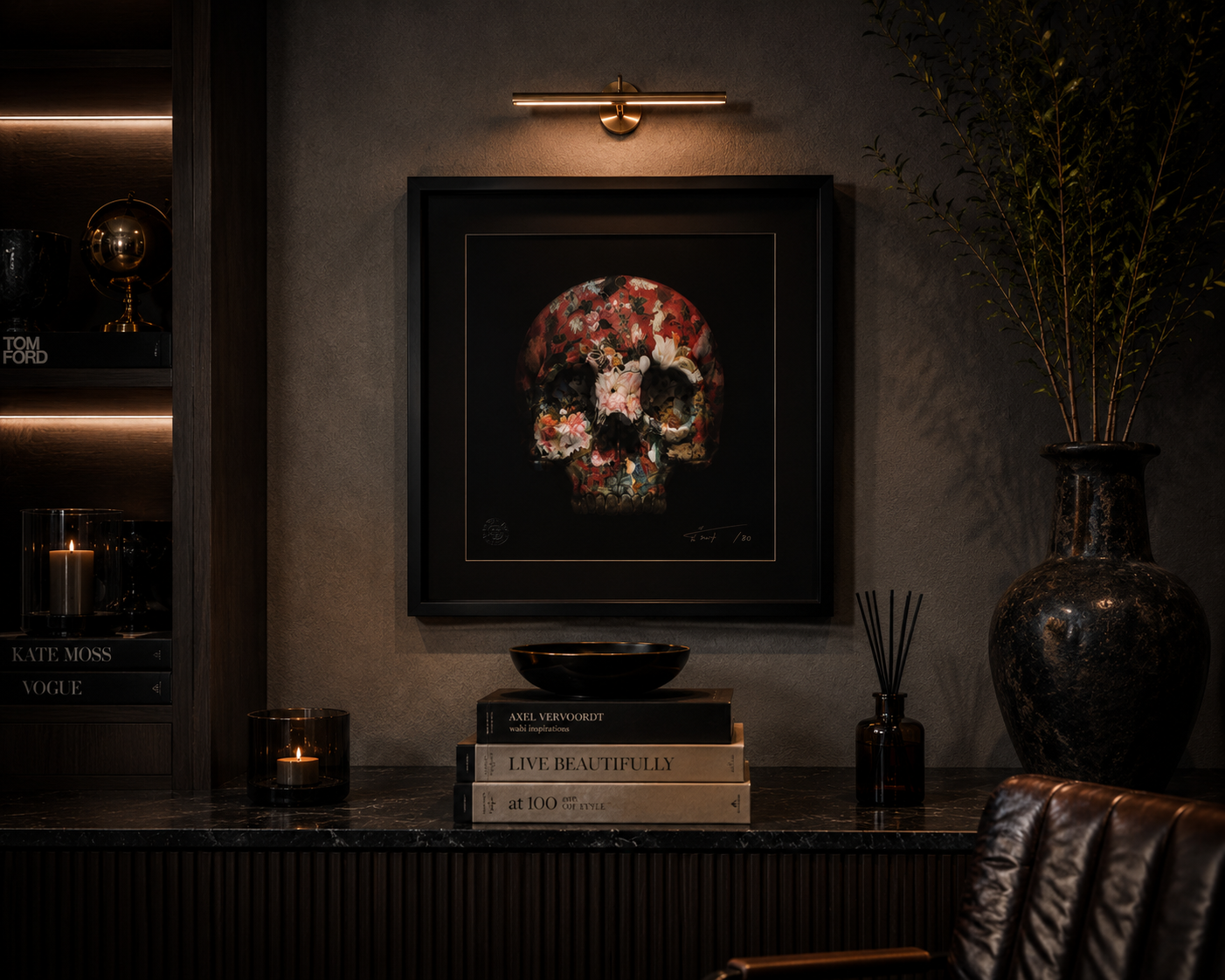
THERE IS STRONG SHADOW WHERE THERE IS MUCH LIGHT — RED
Magnus Gjoen
2019
Limited Edition of 80
50 × 50 cm
Archival pigment inks and silk-screen varnish on 308gsm cotton rag
Signed and numbered by the artist
From The Allun Lewis Collection
THE STORY BEHIND THE PIECE
There are some artworks where the title changes the way you see the image.
For me, this is one of them.
There Is Strong Shadow Where There Is Much Light.
Before you even begin looking at the artwork itself, those words create a tension.
Light and darkness.
Beauty and mortality.
Life and death.
And then you see the skull.
BEAUTY IN THE DARKNESS
At first glance, the imagery couldn't be more familiar.
A human skull.
One of the oldest symbols of mortality in art.
But Magnus doesn't present it as something cold or frightening.
Instead, the skull is consumed by flowers.
Rich reds, delicate whites, flashes of blue and green appear from the darkness, transforming something we instinctively associate with death into something unexpectedly beautiful.
It's a modern interpretation of the memento mori tradition — art that reminds us that life is temporary. Enter Gallery similarly describes the work as celebrating the fragility of being alive through blossoming flowers.
And I think that's what makes the piece so effective.
The flowers don't remove the darkness.
They exist within it.
THERE IS STRONG SHADOW WHERE THERE IS MUCH LIGHT
The title comes from a line attributed to Johann Wolfgang von Goethe:
“There is strong shadow where there is much light.”
I love that idea.
Because the two aren't necessarily opposites.
Perhaps one exists because of the other.
We recognise happiness because we've experienced sadness.
We appreciate success because we've experienced failure.
We understand how precious moments can be because somewhere in the background sits the knowledge that none of them last forever.
And perhaps that's what the skull represents.
Not death in a sinister sense.
Perspective.
LOOK CLOSER
From a distance, you see a skull.
Move closer and something else begins to happen.
The mortality almost disappears.
You start noticing the individual flowers, colours, textures and tiny details woven throughout the image.
And suddenly you're looking at life rather than death.
I think that's very clever.
Because depending on where you stand — both literally and metaphorically — you can see something completely different.
From one perspective, death surrounds the flowers.
From another, life has completely consumed death.
WHY IT BELONGS IN MY COLLECTION
This piece probably represents my attraction to Magnus's work as well as almost anything I own.
It isn't simply beautiful.
There is a contradiction sitting underneath the beauty.
Magnus repeatedly explores that territory — taking imagery associated with mortality, conflict or destruction and presenting it in ways that challenge our preconceived ideas about what we're looking at.
That's exactly the type of artwork I find myself returning to.
I don't particularly want a piece to tell me what to think.
I want it to make me think.
And this one does.
The skull reminds me that our time is finite.
The flowers remind me what we can do with it.
And the title perhaps reminds me that a meaningful life isn't one lived entirely in the light.
Sometimes it's the shadows that allow us to recognise just how bright the light really is.
LIFE THROUGH ANOTHER PERSON'S LENS
That's ultimately why this work belongs within my collection.
Magnus gives us his interpretation of beauty, mortality and the fragile relationship between the two.
I can understand his perspective without having to surrender my own.
And every time somebody else stands in front of it, they'll inevitably bring something different to it again.
Which brings me back to the idea at the heart of my collection:
The freedom to see through somebody else's eyes without surrendering our own.
There will always be shadows.
Perhaps the important thing is recognising the light.
From The Allun Lewis Collection
Magnus Gjoen
2019
Limited Edition of 80
50 × 50 cm
Archival pigment inks and silk-screen varnish on 308gsm cotton rag
Signed and numbered by the artist
From The Allun Lewis Collection
THE STORY BEHIND THE PIECE
There are some artworks where the title changes the way you see the image.
For me, this is one of them.
There Is Strong Shadow Where There Is Much Light.
Before you even begin looking at the artwork itself, those words create a tension.
Light and darkness.
Beauty and mortality.
Life and death.
And then you see the skull.
BEAUTY IN THE DARKNESS
At first glance, the imagery couldn't be more familiar.
A human skull.
One of the oldest symbols of mortality in art.
But Magnus doesn't present it as something cold or frightening.
Instead, the skull is consumed by flowers.
Rich reds, delicate whites, flashes of blue and green appear from the darkness, transforming something we instinctively associate with death into something unexpectedly beautiful.
It's a modern interpretation of the memento mori tradition — art that reminds us that life is temporary. Enter Gallery similarly describes the work as celebrating the fragility of being alive through blossoming flowers.
And I think that's what makes the piece so effective.
The flowers don't remove the darkness.
They exist within it.
THERE IS STRONG SHADOW WHERE THERE IS MUCH LIGHT
The title comes from a line attributed to Johann Wolfgang von Goethe:
“There is strong shadow where there is much light.”
I love that idea.
Because the two aren't necessarily opposites.
Perhaps one exists because of the other.
We recognise happiness because we've experienced sadness.
We appreciate success because we've experienced failure.
We understand how precious moments can be because somewhere in the background sits the knowledge that none of them last forever.
And perhaps that's what the skull represents.
Not death in a sinister sense.
Perspective.
LOOK CLOSER
From a distance, you see a skull.
Move closer and something else begins to happen.
The mortality almost disappears.
You start noticing the individual flowers, colours, textures and tiny details woven throughout the image.
And suddenly you're looking at life rather than death.
I think that's very clever.
Because depending on where you stand — both literally and metaphorically — you can see something completely different.
From one perspective, death surrounds the flowers.
From another, life has completely consumed death.
WHY IT BELONGS IN MY COLLECTION
This piece probably represents my attraction to Magnus's work as well as almost anything I own.
It isn't simply beautiful.
There is a contradiction sitting underneath the beauty.
Magnus repeatedly explores that territory — taking imagery associated with mortality, conflict or destruction and presenting it in ways that challenge our preconceived ideas about what we're looking at.
That's exactly the type of artwork I find myself returning to.
I don't particularly want a piece to tell me what to think.
I want it to make me think.
And this one does.
The skull reminds me that our time is finite.
The flowers remind me what we can do with it.
And the title perhaps reminds me that a meaningful life isn't one lived entirely in the light.
Sometimes it's the shadows that allow us to recognise just how bright the light really is.
LIFE THROUGH ANOTHER PERSON'S LENS
That's ultimately why this work belongs within my collection.
Magnus gives us his interpretation of beauty, mortality and the fragile relationship between the two.
I can understand his perspective without having to surrender my own.
And every time somebody else stands in front of it, they'll inevitably bring something different to it again.
Which brings me back to the idea at the heart of my collection:
The freedom to see through somebody else's eyes without surrendering our own.
There will always be shadows.
Perhaps the important thing is recognising the light.
From The Allun Lewis Collection