

 Image 1 of 1
Magnus Gjoen
2022
Edition 20 of 30
36 × 26 cm
Archival inks on embossed 310gsm cotton rag
Signed and numbered by the artist
From The Allun Lewis Collection
Sometimes contemporary art doesn't need to shout.
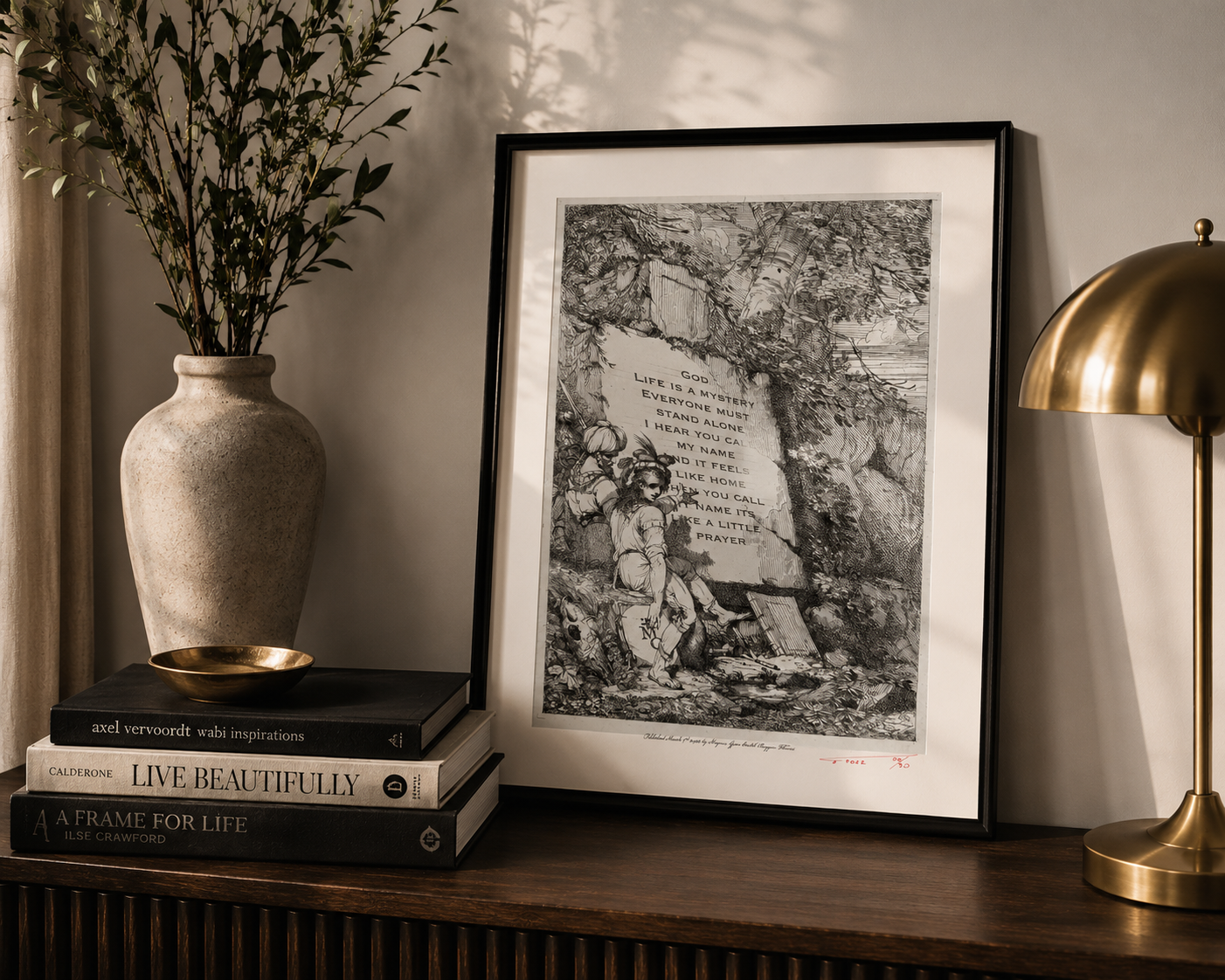
At first glance, Like A Prayer feels as though it could have been lifted from another century.
The monochrome landscape, the extraordinary detail and the children gathered beside the stone give the work the appearance of an old engraving or forgotten historical illustration.
And then you begin to read the words.
“Life is a mystery
Everyone must stand alone
I hear you call my name
And it feels like home…”
Suddenly, the piece becomes something completely different.
Words many of us immediately associate with Madonna's Like a Prayer have been transported from popular culture and placed into an image that appears to belong to another time entirely.
And I love that contradiction.
It's something I find myself continually drawn towards in Magnus's work.
He takes imagery that feels historic, classical or almost sacred and introduces something completely contemporary.
The two shouldn't necessarily belong together.
Yet somehow they do.
Removed from the music and placed within this setting, the words begin to take on another meaning.
Life is a mystery.
Everyone must stand alone.
I hear you call my name.
Read as an inscription rather than heard as lyrics, something familiar suddenly feels philosophical — perhaps even spiritual.
And that's what makes this piece particularly clever to me.
It's immediately recognisable once you understand what you're looking at, but until that moment it could quite easily pass as something created centuries ago.
My example is number 20 from an edition of just 30, signed and numbered by Magnus.
I don't collect art because of an edition number, but I do enjoy these details. They give each individual work its own place within the wider story of an edition.
This one happens to be:
20 / 30
One of only thirty.
The more my collection has developed, the more I've realised that I'm drawn to artwork that makes you look once — and then makes you look again.
Like A Prayer does exactly that.
From across the room, you could believe you're looking at an antique engraving.
Move closer and everything changes.
Contemporary popular culture has been hidden inside something that appears centuries old.
But underneath that clever juxtaposition is something else I particularly like.
Meaning changes depending on who's standing in front of the artwork.
One person might see Madonna.
Another might see religion.
Someone else might see loneliness, love, faith or simply a beautifully constructed image.
And perhaps that's why this little piece fits so naturally within my collection.
Because it comes back to the philosophy behind the collection itself:
The freedom to see through somebody else's eyes without surrendering our own.
Magnus gives us the image.
What we see within it is ultimately ours.
From The Allun Lewis Collection
Magnus Gjoen
2022
Edition 20 of 30
36 × 26 cm
Archival inks on embossed 310gsm cotton rag
Signed and numbered by the artist
From The Allun Lewis Collection
Sometimes contemporary art doesn't need to shout.
At first glance, Like A Prayer feels as though it could have been lifted from another century.
The monochrome landscape, the extraordinary detail and the children gathered beside the stone give the work the appearance of an old engraving or forgotten historical illustration.
And then you begin to read the words.
“Life is a mystery
Everyone must stand alone
I hear you call my name
And it feels like home…”
Suddenly, the piece becomes something completely different.
Words many of us immediately associate with Madonna's Like a Prayer have been transported from popular culture and placed into an image that appears to belong to another time entirely.
And I love that contradiction.
It's something I find myself continually drawn towards in Magnus's work.
He takes imagery that feels historic, classical or almost sacred and introduces something completely contemporary.
The two shouldn't necessarily belong together.
Yet somehow they do.
Removed from the music and placed within this setting, the words begin to take on another meaning.
Life is a mystery.
Everyone must stand alone.
I hear you call my name.
Read as an inscription rather than heard as lyrics, something familiar suddenly feels philosophical — perhaps even spiritual.
And that's what makes this piece particularly clever to me.
It's immediately recognisable once you understand what you're looking at, but until that moment it could quite easily pass as something created centuries ago.
My example is number 20 from an edition of just 30, signed and numbered by Magnus.
I don't collect art because of an edition number, but I do enjoy these details. They give each individual work its own place within the wider story of an edition.
This one happens to be:
20 / 30
One of only thirty.
The more my collection has developed, the more I've realised that I'm drawn to artwork that makes you look once — and then makes you look again.
Like A Prayer does exactly that.
From across the room, you could believe you're looking at an antique engraving.
Move closer and everything changes.
Contemporary popular culture has been hidden inside something that appears centuries old.
But underneath that clever juxtaposition is something else I particularly like.
Meaning changes depending on who's standing in front of the artwork.
One person might see Madonna.
Another might see religion.
Someone else might see loneliness, love, faith or simply a beautifully constructed image.
And perhaps that's why this little piece fits so naturally within my collection.
Because it comes back to the philosophy behind the collection itself:
The freedom to see through somebody else's eyes without surrendering our own.
Magnus gives us the image.
What we see within it is ultimately ours.
From The Allun Lewis Collection