

 Image 1 of 1
Magnus Gjoen
2022
Edition 61 of 150
25 × 17.5 cm
Archival ink on 300gsm cotton rag
Signed and numbered by the artist
From The Allun Lewis Collection
Love is usually represented by hearts, flowers and romance.
Magnus gives us something rather different.
At first glance, Anatomy of Cupid is almost playful.
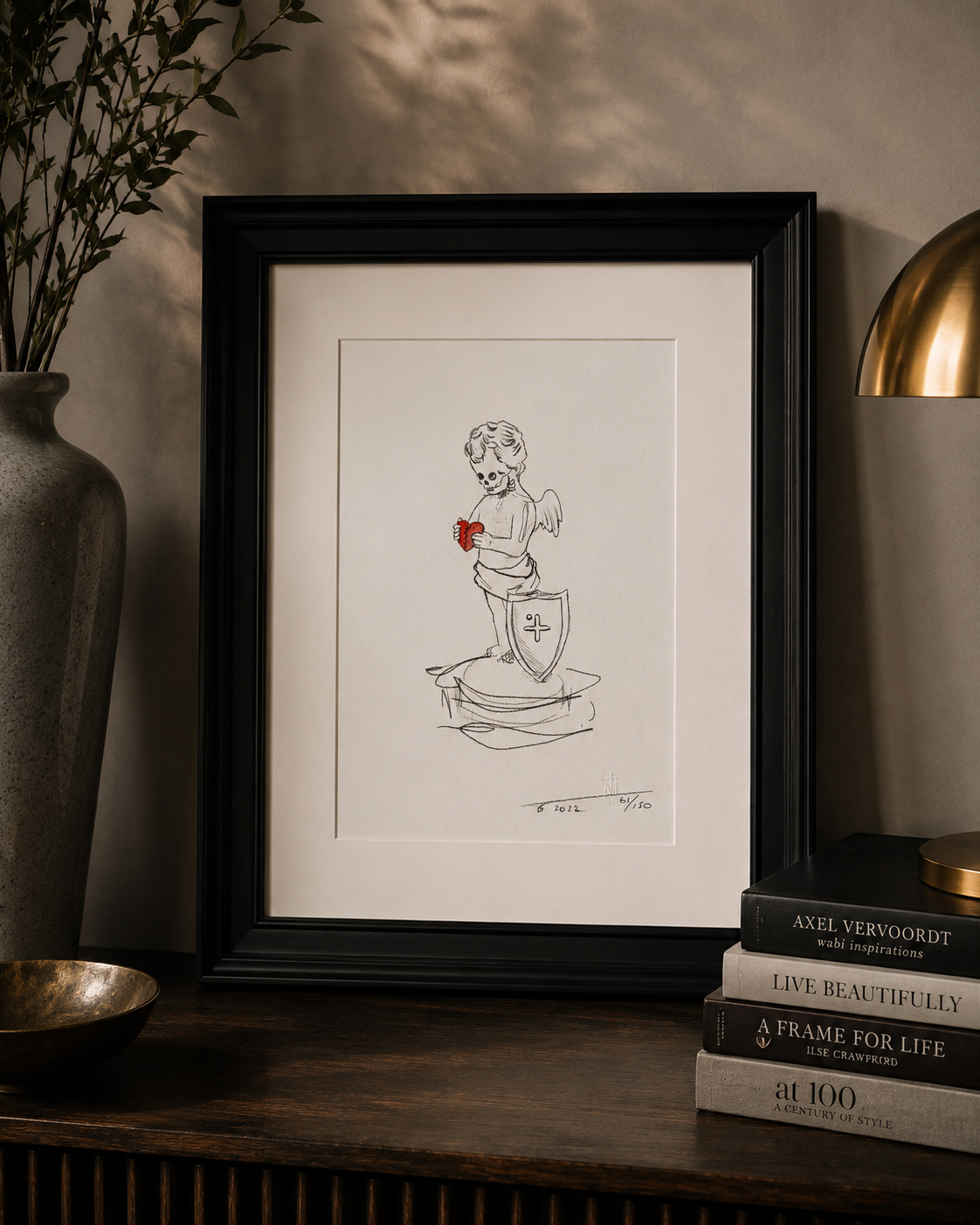
A tiny winged cherub stands alone against an expanse of white paper. In his hands is the one burst of colour within the entire composition — a vivid red heart.
But then you look at his face.
Cupid is a skeleton.
And suddenly this seemingly innocent little image begins to say considerably more.
Cupid has represented love and desire for centuries.
We normally encounter him as an innocent, youthful figure armed with a bow and arrow, capable of making people fall helplessly in love.
Here, Magnus strips that familiar character back to the one thing none of us can escape.
Mortality.
Yet Cupid is still holding the heart.
That's the detail I find most interesting.
The body has changed. The innocence has disappeared. Mortality is staring directly back at us.
But the heart remains.
For me, there's something surprisingly optimistic about that.
Beside Cupid sits a shield.
That changes the way I see the piece again.
Perhaps the heart isn't simply something Cupid possesses.
Perhaps it's something he's protecting.
And there's an idea within that which I particularly like.
We spend so much of our lives protecting ourselves from being hurt. Experience makes us more cautious. Relationships leave their marks. Time changes us.
Yet completely protecting ourselves would require us never to risk loving anything in the first place.
And what sort of life would that be?
The things capable of hurting us most are often the things that matter to us most.
Love makes us vulnerable.
Perhaps that's precisely why it's worth protecting.
My example is number 61 from the edition of 150, signed and numbered by Magnus.
It's a relatively small work, and I think that actually suits it.
There is no huge explosion of colour or elaborate composition competing for your attention.
Just Cupid.
A heart.
A shield.
And an enormous amount of empty space.
Everything that matters has been reduced to a handful of symbols.
The more Magnus works I've collected, the more I've realised that the pieces don't necessarily need to be large or visually complicated to make me think.
Sometimes the simplest images raise the biggest questions.
Is Cupid protecting the heart?
Is the heart all that remains?
Does love survive mortality?
Or is Magnus simply reminding us that even Cupid eventually meets the same fate as everybody else?
I don't think I need to know the answer.
In fact, I'd rather not.
Because that's part of what I enjoy about art.
The artist can give us the symbols.
We decide what they mean.
And every time I look at this little Cupid clutching his red heart, I find myself coming back to the same thought:
If something is worth loving, perhaps it's worth being vulnerable for.
From The Allun Lewis Collection
Magnus Gjoen
2022
Edition 61 of 150
25 × 17.5 cm
Archival ink on 300gsm cotton rag
Signed and numbered by the artist
From The Allun Lewis Collection
Love is usually represented by hearts, flowers and romance.
Magnus gives us something rather different.
At first glance, Anatomy of Cupid is almost playful.
A tiny winged cherub stands alone against an expanse of white paper. In his hands is the one burst of colour within the entire composition — a vivid red heart.
But then you look at his face.
Cupid is a skeleton.
And suddenly this seemingly innocent little image begins to say considerably more.
Cupid has represented love and desire for centuries.
We normally encounter him as an innocent, youthful figure armed with a bow and arrow, capable of making people fall helplessly in love.
Here, Magnus strips that familiar character back to the one thing none of us can escape.
Mortality.
Yet Cupid is still holding the heart.
That's the detail I find most interesting.
The body has changed. The innocence has disappeared. Mortality is staring directly back at us.
But the heart remains.
For me, there's something surprisingly optimistic about that.
Beside Cupid sits a shield.
That changes the way I see the piece again.
Perhaps the heart isn't simply something Cupid possesses.
Perhaps it's something he's protecting.
And there's an idea within that which I particularly like.
We spend so much of our lives protecting ourselves from being hurt. Experience makes us more cautious. Relationships leave their marks. Time changes us.
Yet completely protecting ourselves would require us never to risk loving anything in the first place.
And what sort of life would that be?
The things capable of hurting us most are often the things that matter to us most.
Love makes us vulnerable.
Perhaps that's precisely why it's worth protecting.
My example is number 61 from the edition of 150, signed and numbered by Magnus.
It's a relatively small work, and I think that actually suits it.
There is no huge explosion of colour or elaborate composition competing for your attention.
Just Cupid.
A heart.
A shield.
And an enormous amount of empty space.
Everything that matters has been reduced to a handful of symbols.
The more Magnus works I've collected, the more I've realised that the pieces don't necessarily need to be large or visually complicated to make me think.
Sometimes the simplest images raise the biggest questions.
Is Cupid protecting the heart?
Is the heart all that remains?
Does love survive mortality?
Or is Magnus simply reminding us that even Cupid eventually meets the same fate as everybody else?
I don't think I need to know the answer.
In fact, I'd rather not.
Because that's part of what I enjoy about art.
The artist can give us the symbols.
We decide what they mean.
And every time I look at this little Cupid clutching his red heart, I find myself coming back to the same thought:
If something is worth loving, perhaps it's worth being vulnerable for.
From The Allun Lewis Collection